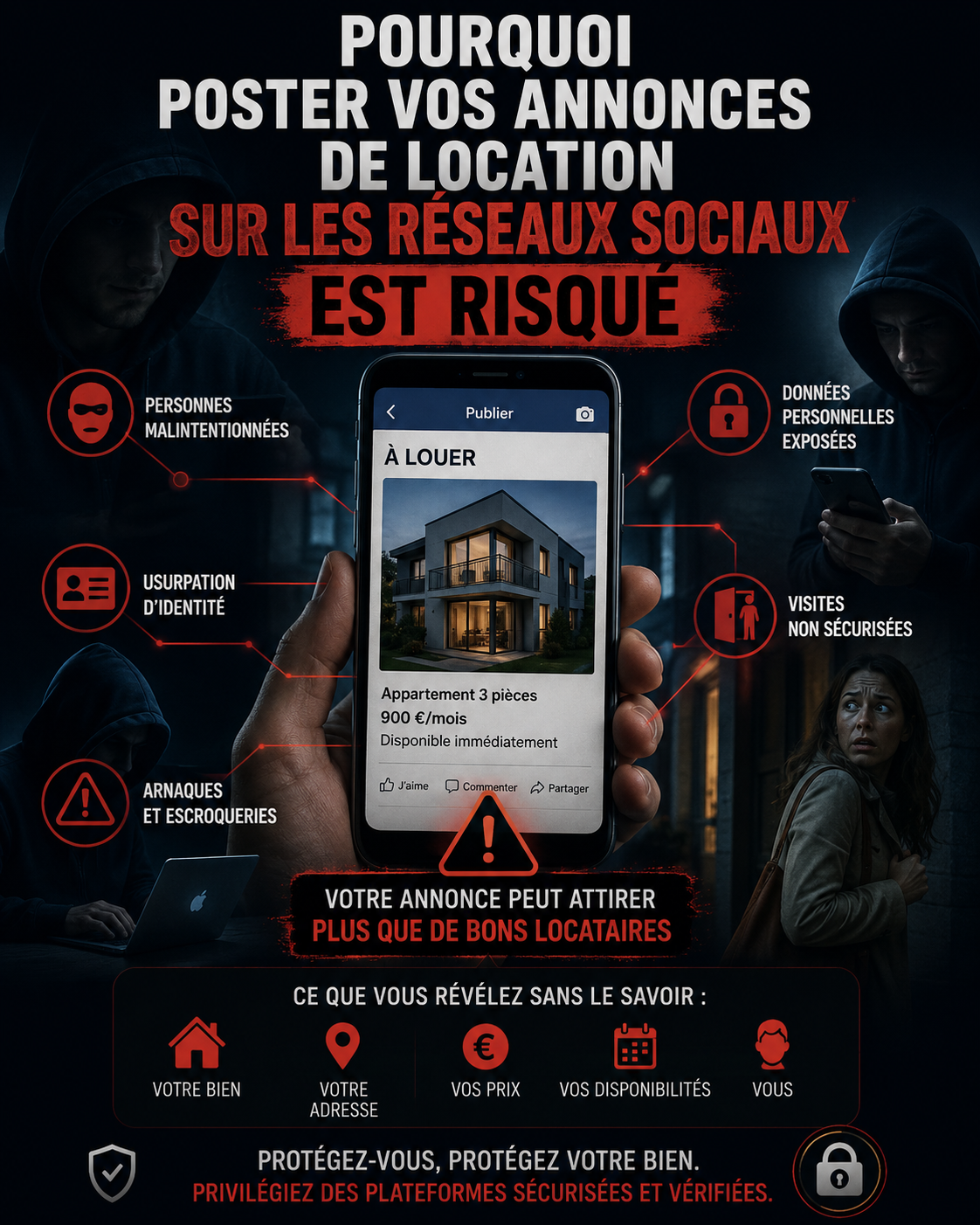
Publishing your rental listings on Facebook, Instagram or TikTok may seem quick and free: in reality, it's one of the riskiest decisions you can make as a landlord or estate agent. Between identity theft, GDPR, unqualified applicants and zero control over your data, social media has become a minefield for rental property.
Why do social media platforms attract property fraudsters?
Social platforms have no serious identity verification mechanism for property listings. Anyone can create a fake account, copy your photos and republish your property at a lower rent to trap prospective tenants. This phenomenon is exploding: fraudsters are creating fake estate agency accounts from scratch and offering superb flats to rent, particularly on TikTok and Facebook Marketplace.
The mechanism is always the same:
- The scammer copies your listing (photos, description, address) and republishes it with their own contact details.
- They request a deposit or "reservation fee" before any viewing.
- They collect personal documents (identity card, salary slips) to reuse them in identity fraud.
- They disappear after payment, leaving victims with no accommodation and no refund.
As a landlord or agency, you also suffer the damage: your property and your name can be used without your consent, tarnishing your reputation with victims who thought they were dealing with you.
What GDPR risks for landlords and agencies who publish on social media?
Publishing a listing on social media also exposes you to often-underestimated legal risks. As soon as a listing generates applications, you collect personal data (name, contact details, income). However, GDPR imposes strict obligations: legal basis, transparency, retention period, right to erasure.
On a social network, you are not in control of the processing of this data: private messages, forms completed via platforms, attachments sent by instant messaging all escape any secure framework. All property professionals are subject to GDPR as soon as they collect personal data, and failure to comply with these obligations exposes them to heavy sanctions.
In Belgium, the regulation applies identically via the General Data Protection Regulation, transposed in each region. In France, the CNIL has expressly identified real estate as a priority sector for monitoring.
No applicant qualification: the trap of quantity without quality
Social media maximise visibility but minimise reliability. On a social platform, you have no means to:
- Verify the real identity of an applicant.
- Check the consistency of their documents.
- Assess their actual payment behaviour on past rentals.
The rental market is already under pressure. According to the LocService Observatory (2025), there are on average 4.69 applicants per rental offer in France, a competition that drives some applicants to embellish their file. In Belgium, according to Immoweb (2024), a single available property can attract up to 34 tenant applicants on average. In this context, receiving unfiltered applications via social media means drowning the essential in the superficial.
Moreover, according to a FLASHS study for Zelok (2025), 58% of French landlords have already detected or suspected a fraudulent rental file. Social media offer no safety net against this risk: no document analysis, no payment history, no rental reliability score.
Listing copying and property impersonation: a real risk for your photos and data
A listing published publicly on a social network is indexable, downloadable and copyable in seconds. Your property photos, the precise location, information about the surface area and facilities become immediately exploitable by malicious third parties.
This is not a theoretical risk: phantom lease scams are multiplying on online platforms. Scammers rent flats via short-term rental services, take photos, then publish fake listings posing as the owners. Result: trapped tenants lose several thousand euros in deposits, and real landlords see their property associated with a scam.
How to secure your rental process without using social media?
Best practice is to publish your listings on specialised platforms with verification mechanisms, and to require applicants to submit a structured and certified file to you, on their own initiative, not under pressure.
This is exactly what we have built at ImmoTecto. The TectoPass is a certified rental passport that the tenant compiles themselves: identity, history of actual rent payments, employment situation, guarantors. It is shared with you via QR code or digital code, and you only see what the tenant has agreed to show you. To view it, simply create an ImmoTecto account at €0, which includes 10 TectoPass consultations in total.
The Tecto Score measures only the tenant's actual payment behaviour – have they paid their rent on the scheduled date – on a scale of 0 to 100, with increased weighting of recent payments. No income, savings or family situation data is included in this calculation. The Tecto Score is never the sole selection criterion: it is part of a comprehensive approach, compliant with anti-discrimination requirements in force in Belgium, France and all countries where ImmoTecto is active.
Rather than posting into the void of a news feed, discover our offers for landlords and agencies: secure listings, certified files and an application process that protects all parties.
FAQ
Can your listing really be impersonated on social media?
Yes, this is a documented risk that is rising sharply. A publicly published photo can be copied in seconds and republished with a scammer's contact details. Specialised platforms that verify listings now block a significant proportion of fraudulent publications before going live; social networks have no equivalent mechanism.
Are social media really subject to GDPR for a property listing?
Yes. As soon as a listing generates exchanges with prospective tenants, you collect personal data. This collection must comply with GDPR: legal basis, information of data subjects, limited retention period. On a social network, you do not control the data processing chain, which exposes you to risks of non-compliance.
How to verify a tenant's reliability without using social media?
Ask the tenant to share a TectoPass with you: a certified passport that contains their Tecto Score (based on their actual payment behaviour), their documents and their guarantors. The tenant chooses what they share, you consult instantly via QR code from your ImmoTecto account at €0. It's faster, more secure and GDPR-compliant.
Which landlords are affected by these risks?
All landlords, whether managing a single property or several, in Belgium, France or other countries where ImmoTecto is active. The risk of listing copying and document fraud does not depend on the size of the property portfolio: as soon as a listing is published on a social network, it is exposed.
Does TectoPass replace a complete tenant file verification?
No, and that's intentional. TectoPass centralises the information that the tenant agrees to share, with AI document consistency analysis (coherence check). It does not replace the landlord's judgement or other legal selection criteria. It provides an additional layer of reliability, at the tenant's own initiative.
Sources
- Annonces immobilières sur TikTok : trois conseils pour ne pas se faire arnaquer, France 3 Régions, 2026, press
- Immobilier : les arnaques aux faux propriétaires se multiplient, Franceinfo, 2025, press
- Comment réagir en cas d'arnaques à la location immobilière ?, Cybermalveillance.gouv.fr, 2025, official
- RGPD : Obligations et conformité des agences immobilières, Leto Legal, 2026, report
- Référentiel relatif aux traitements de données personnelles mis en œuvre dans le cadre de la gestion locative, CNIL, 2023, official
- Les arnaques à la location se multiplient (Belgique), RTBF, 2025, press
- Étude FLASHS pour Zelok, fraude locative France, Zelok / FLASHS, 2025, study
- Observatoire LocService 2025, tension locative France, LocService, 2025, study
- Baromètre Immoweb, marché locatif belge, Immoweb, 2024, study