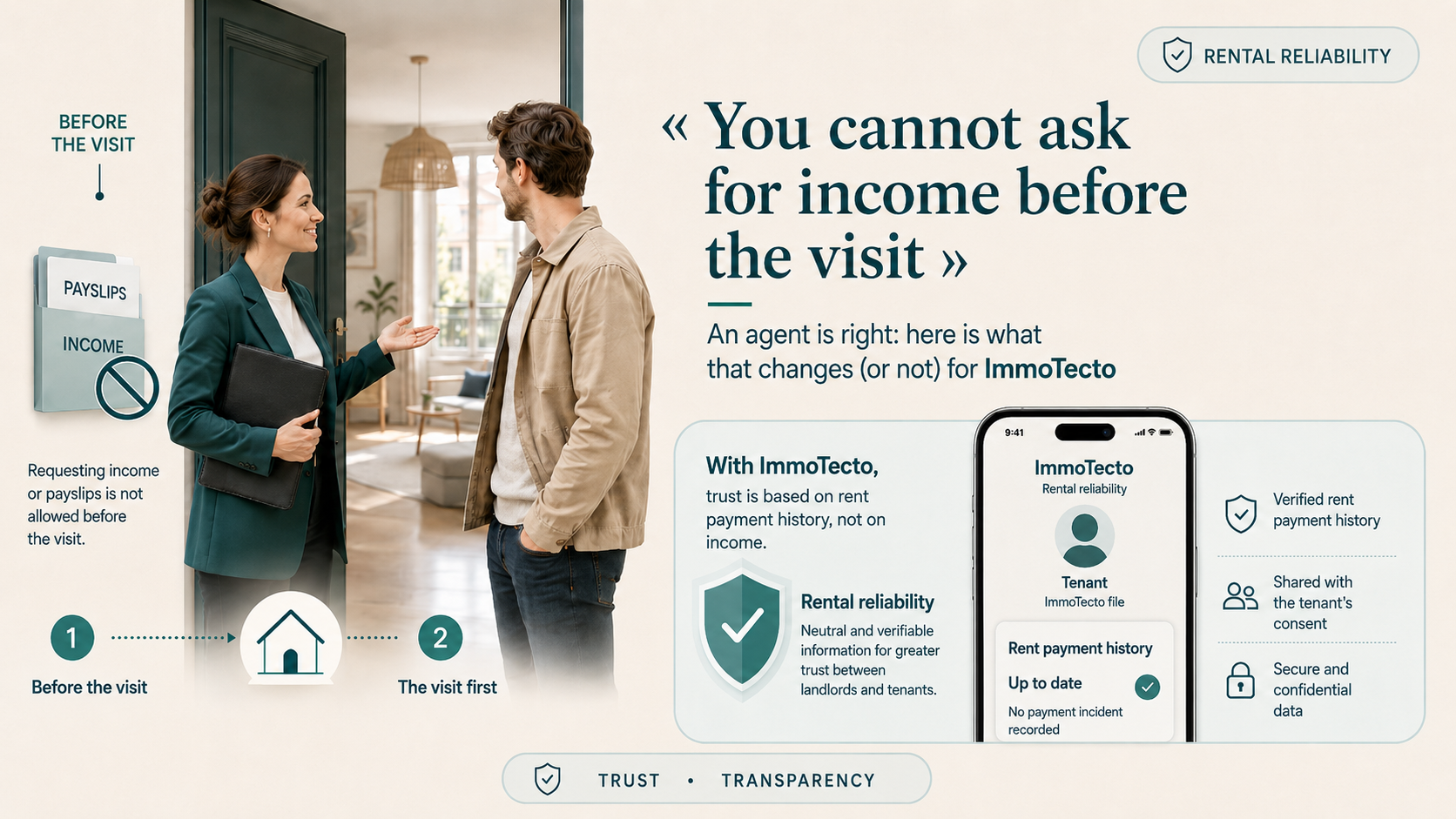
"You can't ask for income before the viewing": an agent is right, and here's what that changes (or doesn't) for Immotecto
A Dutch-speaking estate agent recently raised a specific objection with us: in Belgium, you cannot request a candidate's financial information before the property viewing. He's right. On this point, the rule is clear and we don't dispute it. But it doesn't call into question how Immotecto works, and it's worth explaining why, without taking shortcuts.
The rule really exists, and it differs by region
When it's the agency or the landlord who requests documents in a rental procedure, the timeline is regulated. Before the viewing, only a name and contact details can be requested. Only afterwards, at the selection stage, can proof of income be requested.
The foundation is regional:
- In Brussels, the Housing Code (art. 200ter) sets out a limited list and a three-stage timeline: contact details before the viewing, amount of income and household size to support the application, identity documents and civil status only for the selected candidate.
- In Wallonia, the decree of 15 March 2018 lists eight pieces of data that can be required, including proof of payment of the last three months' rent.
- In Flanders, the Woninghuurdecreet (art. 7) establishes a principle of necessity, without a legal list or dated timeline. The rule "contact details before viewing, income afterwards" is a best practice confirmed by the data protection authority, not a specific legal article.
So our Dutch-speaking agent is describing exactly the rule that applies to him. The important point is knowing who it governs.
This rule regulates the agency's request, not the file prepared by the candidate
The logic of the timeline protects candidates against an agency that would demand too much, too soon. It addresses a situation where it's the professional who makes the request.
The Immotecto case is different. Here, it's not the agency requesting. It's the candidate who, on their own initiative, prepares their file and chooses to share it to maximise their chances. The Belgian data protection authority described this phenomenon as early as 2009: candidates "sometimes spontaneously submit" a series of documents to ensure the maximum chance of obtaining the desired property.
That's precisely our model. The candidate builds their TectoDossier, obtains their TectoPass, and presents it. The agency doesn't conduct an investigation: it reviews an already-prepared file that the candidate has decided to show them.
Transparency, without which the argument wouldn't hold
It would be dishonest to stop there, and the regulator itself sets the limit in the same sentence. The fact that a candidate voluntarily provides their documents "does not automatically make the collection of this data compliant" with the law. In other words: the candidate's initiative lifts the timeline constraint on the agency, but it doesn't exempt anyone from the basic principles.
We fully embrace these. Immotecto is a data controller within the meaning of GDPR, and as such we guarantee a specific purpose, data minimisation, a clear legal basis and limited retention periods. TectoPass deliberately remains focused on what serves its purpose, because an accumulation of otherwise harmless data can cease to be proportionate.
And we will never claim that voluntary sharing "immunises" the agency. The agency remains responsible for its rental decision. It cannot refuse a candidate on protected grounds, regardless of how the information reached them. On this front, our positioning helps rather than harms.
Why "payment reliability" protects better than a judgment on income
All three regions converge on one point: only the amount of income is relevant, never its nature or source. Rejecting a candidate because they receive replacement income (unemployment, social assistance, pension, disability benefit) is discriminatory.
That's exactly why Immotecto measures actual payment reliability, not a type of income. We don't do credit scoring and make no judgment about the origin of a person's income. The Tecto Score reflects an actually observed rental payment history. An agency relying on this information looks at demonstrated payment behaviour, not an income category, which places it on the right side of the anti-discrimination rule.
This approach aligns with what judges uphold. The Council of State ruled in 2026 that the requirement for income equivalent to three times the rent and charges is not disproportionate for verifying the ability to pay, and does not in itself constitute discrimination based on wealth. What's validated is the amount criterion. What remains prohibited is selection based on the nature or source of income. The distinction is exactly the one on which we build.
Open Banking: reliable proof, never an obligation
To establish a real payment history, the most reliable route is bank connection via Open Banking, governed by the PSD2 directive. Data comes directly from the bank, under strong authentication, which eliminates the risk of false documents. Our aggregation partner is licensed and PSD2 certified in Belgium.
Two safeguards, because they are the condition of the system's validity:
- Bank connection is optional. Candidates who refuse it have a genuinely usable alternative path. Consent is only "freely given" if the service doesn't make it conditional.
- Consent is revocable at any time, as simply as it was given, and limited in time.
What an agency can take away from this
The initial objection was correct, and we prefer to acknowledge it rather than bypass it. The rule of "no finances before viewing" governs what the agency can request. It doesn't regulate a file that a candidate has prepared and chosen to share voluntarily, provided the platform respects GDPR throughout. That's what we do, and that's what allows an agency to use a TectoPass with confidence: it reviews verifiable information, focused on payment reliability, without ever crossing the line into discrimination.