Why the Rental Supply Continues to Shrink in France
By Émeline
27 June 2026
The decline in rental supply is permanently transforming the French property market. Between investor withdrawals, energy standards and slower construction rates, discover why rental properties are becoming increasingly scarce in 2026.

Prove your rental reliability, or verify a candidate's
Declining rental supply France 2026 The reduction in rental supply in France can no longer be analysed as a simple temporary market adjustment. In 2026, indicators converge towards a clear observation: the contraction of supply is part of a structural dynamic. This evolution results from a sequence of individual decisions and collective constraints which, combined, are permanently transforming the rental landscape.
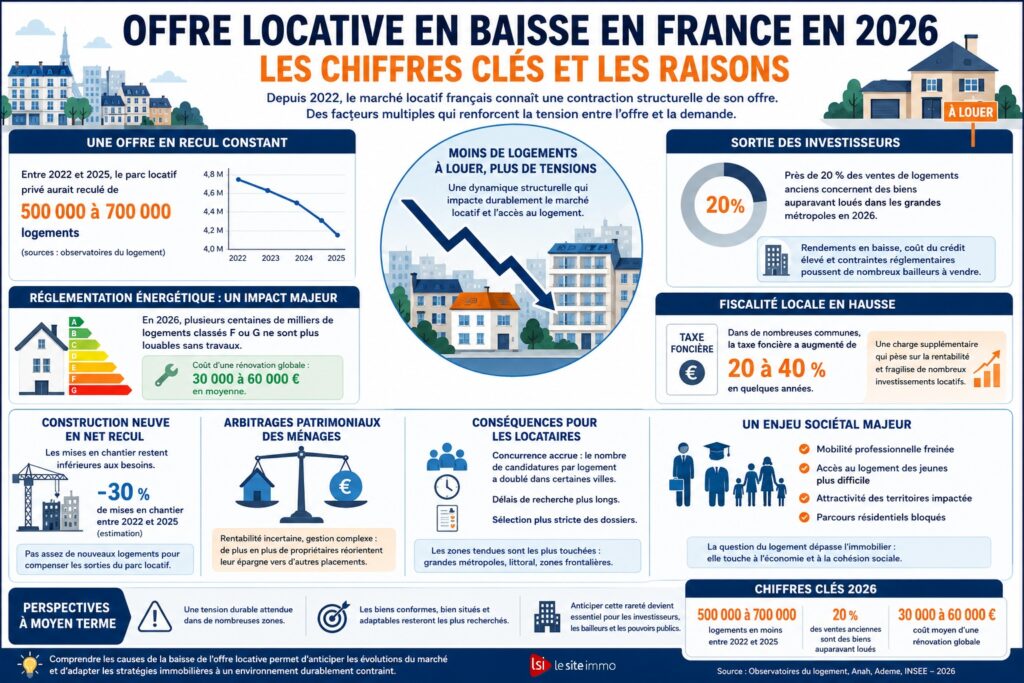
Between 2022 and 2025, the private rental stock fell by several hundred thousand properties. According to cross-estimates from housing observatories. This decrease, although gradual, is exerting immediate pressure on local markets, particularly in already tight areas.
One of the main drivers of the decline in rental supply lies in the gradual exit of private investors. The increase in borrowing costs, compression of yields, and regulatory tightening. These are the reasons that have altered the economic balance of many projects.
In 2026, a growing proportion of landlords are choosing to sell. Rather than retain a property that has become less profitable or more burdensome to manage. In some major cities, nearly 20% of sales of older properties now concern properties that were previously rented. This shift directly contributes to the reduction in available supply.
 ### How are energy regulations accentuating the decline in rental supply in France in 2026?
Energy regulations play a decisive role in the restructuring of the rental stock. Restrictions targeting the most energy-inefficient properties have led to the temporary or permanent withdrawal of many properties from the market. In 2026, several hundred thousand properties classified F or G can no longer be rented without renovation work.
Faced with renovation costs that can reach €30,000 to €60,000 for comprehensive renovation. Many owners are giving up on keeping their property available for rent. This situation particularly affects older town centres. Places where buildings are less readily suited to rapid and economical energy improvements.
Local taxation constitutes an often underestimated factor in the analysis of declining rental supply. The increase in property tax observed in many municipalities has increased landlords' fixed costs. In some cities, this tax has risen by 20 to 40% in just a few years.
In 2026, this charge directly weighs on owners' cash flow and undermines the balance of many investments. For some landlords, local taxation becomes a trigger. Whether for the decision to sell or to withdraw the property from the rental market.
The contraction of rental supply is also fuelled by the decline in new construction. Housing starts have fallen significantly in recent years, limiting the arrival of new properties on the market. In 2026, the production of new homes remains below estimated needs.
This shortage of new supply prevents the natural renewal of the rental stock. Properties leaving the market are not being compensated by new lettings. Which accentuates the imbalance between supply and demand.
 ### Why are households' asset allocation decisions evolving?
Landlords are now managing their assets more actively. The growing complexity of rental management, combined with more uncertain profitability. These two factors are encouraging some households to redirect their savings towards other investments considered more transparent or more liquid.
In 2026, rental property is no longer seen as an obvious asset choice. This evolution in behaviour contributes to the gradual reduction in supply. Without, however, leading to an equivalent fall in demand.
The reduction in rental supply has direct consequences on market equilibriums. It increases tension in attractive areas. It reinforces selectivity at entry and lengthens access times to housing for many households.
Figures show that in some urban areas, the number of applications per property has doubled in a few years. This situation reflects a lasting imbalance. Which cannot be resolved without simultaneous action on supply, regulation and housing production.
Beyond economic mechanisms, the decline in rental supply poses a major societal challenge. It affects professional mobility. Access to housing for young households and the ability of regions to attract new workers.
In 2026, the question of rental supply goes far beyond the scope of property investment. It questions collective choices regarding housing, urban planning and energy transition.
In the medium term, the prospects for evolution remain constrained. The decline in new construction and the continuation of energy requirements suggest limited supply in certain areas. In 2026, market players anticipate persistent, even increased tension.
Anticipating means integrating this scarcity into property strategies, whether for investment, rental management or public policies. Compliant properties, well located and adaptable, will remain the most sought after.
The contraction of rental supply now constitutes one of the main challenges facing the French property market. The tensions observed do not result from a single factor, but from the combination of several mutually reinforcing developments: decline in rental investment, slowdown in new construction, energy renovation requirements and continuous increase in charges borne by owners. This accumulation is permanently altering market equilibriums.
This situation produces effects well beyond the property sector. In many regions, difficulties in finding accommodation hinder professional mobility, complicate the settlement of young workers and reduce the economic attractiveness of cities. The scarcer supply becomes, the more intense competition between tenant candidates becomes, with search times lengthening and selection criteria becoming ever more demanding.
At Lesiteimmo.com, we believe that returning to a more balanced rental market requires a comprehensive approach. It is essential to relaunch housing production, support owners in the energy renovation of their property portfolio and offer them a stable and clear regulatory framework. Without these levers, current tensions risk becoming entrenched and making access to housing even more difficult in the years to come.
Conclusion
In 2026, the reduction in rental supply in France is part of a structural dynamic. It is fuelled by the exit of investors, energy regulations, local taxation and the decline in new construction. Figures show that this contraction is not simply a temporary adjustment, but a profound transformation of the market. Understanding these mechanisms allows us to better anticipate upcoming tensions. And to adapt property strategies to a permanently constrained environment.
FAQ – Rental supply
Why is rental supply declining in France? Rental supply is falling due to several factors: rising interest rates, tightening energy standards, increases in property tax, declining new construction and investor asset allocation decisions. Many owners prefer to sell their property rather than continue a rental activity that has become less profitable. Are properties classified F and G disappearing from the market? Some of the most energy-inefficient properties are indeed leaving the rental market. When renovation work is deemed too costly, some owners choose to sell their property or keep it vacant rather than commit the necessary investment to comply with regulations. Why has it become more difficult to find a rental? Demand for housing remains very high while the number of available properties is decreasing. This imbalance leads to strong competition between candidates, longer search times and more rigorous selection of applications in the most attractive cities. Does the decline in new construction have an impact on the rental market? Yes. The slowdown in housing starts limits the arrival of new properties on the market. Properties disappearing from the rental stock are not being replaced quickly enough, which increases tensions in many urban areas. Can the rental supply situation improve in the coming years? An improvement will depend on several factors: the recovery of construction, support for energy renovation, better regulatory visibility for investors and a gradual return of landlord confidence. Without these developments, tensions on the rental market could persist.
You have a property purchase project? Find my property
Tags:
property purchaseflatlandlordnew constructionhousing crisis.rental demandepctaxationrental investmenttenantrentalhousinghouseproperty marketresidential mobilityrental supplyenergy sieveassetsbuilding permitowneryieldenergy renovationproperty taxproperty tensionproperty sale
Ready to rent with confidence? Get your TectoScore or verify a candidate
Finding accommodation without a permanent employment contract or rent receipts is often an uphill battle. Immotecto offers an approach based on real rent payments, verified directly from the tenant's bank, to replace missing documents with concrete proof.
GuideImmotecto is the rental portal where tenants build their file once and present it instantly via a certified TectoPass. Landlords and agencies save time, tenants prove their reliability.
GuideOpen Banking verifies tenant reliability through actual payment data, in read-only mode and with their consent. How it works and what safeguards are in place.