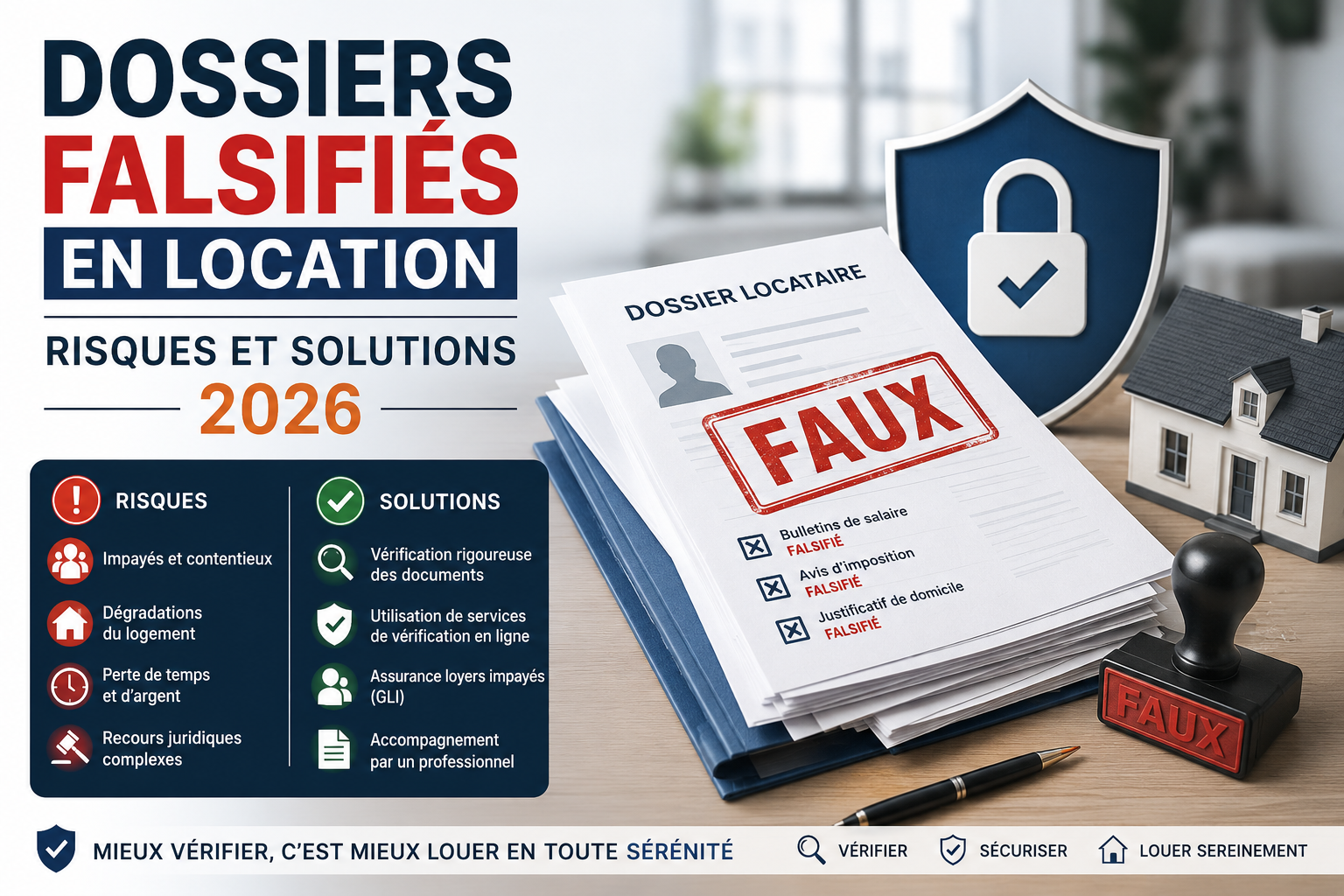
Rental application fraud is no longer a marginal phenomenon: according to Imodirect (2026), 24% of applications submitted in the Île-de-France region contain at least one fraudulent element, compared to 20% in 2024. For landlords and agencies, detecting these falsifications in time is not an option—it's a necessity.
Why are rental applications increasingly being falsified?
The tight French rental market is the primary explanatory factor. Faced with a shortage of available properties and ever-stricter selection criteria, some candidates are tempted to "enhance" their application.
According to a FLASHS study conducted in June 2025 among 2,000 French people, 26% of tenants admit to having already provided inaccurate information, and 48% say they would be willing to falsify their application. These figures reveal a phenomenon that has become systemic.
The most frequently altered documents are:
- Payslips, inflated to reach the required income threshold (generally three times the rent)
- Employment contracts, transformed from fixed-term to permanent contracts or entirely fabricated
- Tax notices, with amounts adjusted to match falsified payslips
- Employer attestations and rent receipts, manufactured to simulate professional or residential stability
With today's digital tools, changing a "2" to a "3" on a payslip takes only seconds. Imodirect (2026) even notes an industrialization of document fraud via generative artificial intelligence tools.
What penalties are incurred for a falsified application?
Falsifying a rental application is not simply an administrative irregularity: it is a criminal offence.
Under criminal law:
- Forgery and use of forged documents (Article 441-1 of the Criminal Code) is punishable by three years' imprisonment and a €45,000 fine
- If the falsification is reclassified as fraud (Article 313-1 of the Criminal Code), the penalty rises to five years' imprisonment and a €375,000 fine
- Additional penalties may apply: criminal record entry, prohibition of certain civil rights
Under civil law:
- If the fraud is discovered before signing, the landlord simply rejects the application
- If discovered during the tenancy, the landlord can request cancellation of the lease for fraud (Article 1137 of the Civil Code): the contract is deemed never to have existed, and eviction can be expedited
- The tenant may be ordered to pay damages covering relocation costs and lost rent
Important point for landlords: according to French case law, the landlord is not required to demonstrate particular diligence. Once their consent has been obtained through fraudulent manoeuvres, fraud is established.
How can you detect a fraudulent rental application?
There is no foolproof technique, but several cross-checks allow detection of the vast majority of frauds.
Checks on payslips:
- Verify consistency between monthly gross salary and displayed annual cumulative total
- Check that social security deductions (contributions) are proportional to the indicated salary
- Confirm the existence and activity of the employer via their SIRET number (accessible on Société.com or Infogreffe)
- Call the employer directly to confirm the position and contract
Checks on tax notices:
- Scan the 2D-Doc barcode present on each modern notice via the dedicated free application: this government technology instantly cross-references data with tax servers
- Verify that the declared annual income corresponds to the sum of payslips for the year
- Check that addresses match between the notice and other application documents
Common warning signs:
- Different font or layout from one document to another from the same issuer
- Poor-quality or poorly positioned scanned signature
- Social security number not corresponding to the candidate's year of birth
- Permanent contract with no probation period mentioned for a recent skilled position
Why are traditional checks no longer sufficient in 2026?
The growing sophistication of falsification tools makes manual verification increasingly inadequate. According to Imodirect (2026), fraudsters now use generative AI tools to produce visually impeccable payslips, tax notices and employment contracts.
Given this reality, 58% of landlords report having already detected or suspected a fraudulent application (FLASHS study for Zelok, 2025). And the cost of a selection error is high: according to Imodirect (2025), the rate of rent arrears reaches 5.33% for properties managed by private individuals, compared to 1.97% for professionals.
This is precisely why we designed the Immotecto approach: not to rely solely on declared documents, but to start from the tenant's actual payment behaviour.
How does Immotecto help combat falsified applications?
Our approach is based on a simple principle: a tenant who has actually paid their rent on time can prove it verifiably, without having to alter a single document.
TectoDossier allows tenants to compile their application once, with documents analysed by our AI (Claude Vision) for consistency checking. Result: a compliant, caution or alert status on each document. This check is not an absolute guarantee of authenticity, but it detects inconsistencies that the human eye might miss.
Tecto Score goes further: it is calculated solely from actually observed rent payments via three cumulative channels: Open Banking (PSD2, read-only), bank statement import (PDF/CSV), or bank statement screenshots. We never analyse income, balance or contract type. Just one question: has this tenant paid their rent on the expected date?
TectoPass is the certified PDF passport that summarises this information. Instantly accessible via QR code or number, it is authenticated in real time by our servers. A professional can scan it without creating an Immotecto account. The tenant chooses section by section what to share, and sees who has consulted their pass.
Result: the agency or landlord accesses real and verifiable payment behaviour, which no altered payslip can imitate.
Tecto Score is never presented as the sole selection criterion. It forms part of an overall assessment, in accordance with anti-discrimination rules applicable in France. The tenant has the right to explanation, challenge and human review (Art. 22 GDPR).
Transparency is always less costly than fraud. For tenants who want to prove their reliability honestly, and for landlords who want to select with confidence, discover how TectoPass works or view our pricing.
FAQ
Which documents are most often falsified in a rental application?
Payslips top the list of falsifications, followed by employment contracts and tax notices. Fraudsters modify amounts, transform fixed-term contracts into permanent ones, or fabricate fictitious employer attestations. Invented rent receipts are also common to simulate residential stability.
What does a tenant who falsifies their rental application risk in France?
Falsifying documents constitutes a criminal offence. Article 441-1 of the Criminal Code provides for up to three years' imprisonment and a €45,000 fine for forgery and use of forged documents. If the facts are reclassified as fraud (Art. 313-1), the penalty can reach five years and €375,000. Under civil law, the lease can be cancelled for fraud and the tenant ordered to pay damages.
Can a landlord cancel a lease signed with a false application?
Yes. French case law recognises that the production of falsified documents that were decisive for concluding the lease constitutes fraud (Art. 1137 of the Civil Code). Cancellation deprives the contract of any legal effect retroactively, which can expedite the eviction procedure and lift winter truce protection in certain cases.
How does Immotecto's Tecto Score avoid falsified applications?
Tecto Score is calculated solely from actually observed rent payments, collected via Open Banking (PSD2), bank statement import or screenshots verified by AI. This real payment behaviour cannot be falsified retrospectively on a document: it is certified in real time by Immotecto servers and accessible via QR code through TectoPass.
Is TectoPass accessible without an account for a professional?
Yes. A landlord or agency can consult a TectoPass by simply scanning the QR code or entering the pass number, without creating an Immotecto account. To access advanced features (listings, tenant directory, bulk consultations), professional plans are available from €0 to discover the platform.
Sources
- Fraude au dossier de location : 26 % des locataires avouent, 48 % prêts à le faire, Zelok / FLASHS (étude auprès de 2 000 Français), 2025, etude
- Crise locative en Île-de-France : les faux dossiers explosent, 24 % en IDF, 16 % en province, MySweetImmo / Imodirect, 2026, presse
- Les impayés de loyer en France : la situation en 2025, taux d'impayés 1,97 % vs 5,33 %, Lamy Immobilier / Imodirect, 2025, rapport
- Falsifier son dossier de location : quels sont les risques ?, article 441-1 et 313-1 Code pénal, Zelok, 2026, presse
- Mon locataire m'a produit des faux documents : annulation du bail pour dol, Derhy Avocat, 2026, officiel
- Immobilier : +40 % des dossiers de location falsifiés en un an, MySweetImmo / Locagestion, 2025, presse