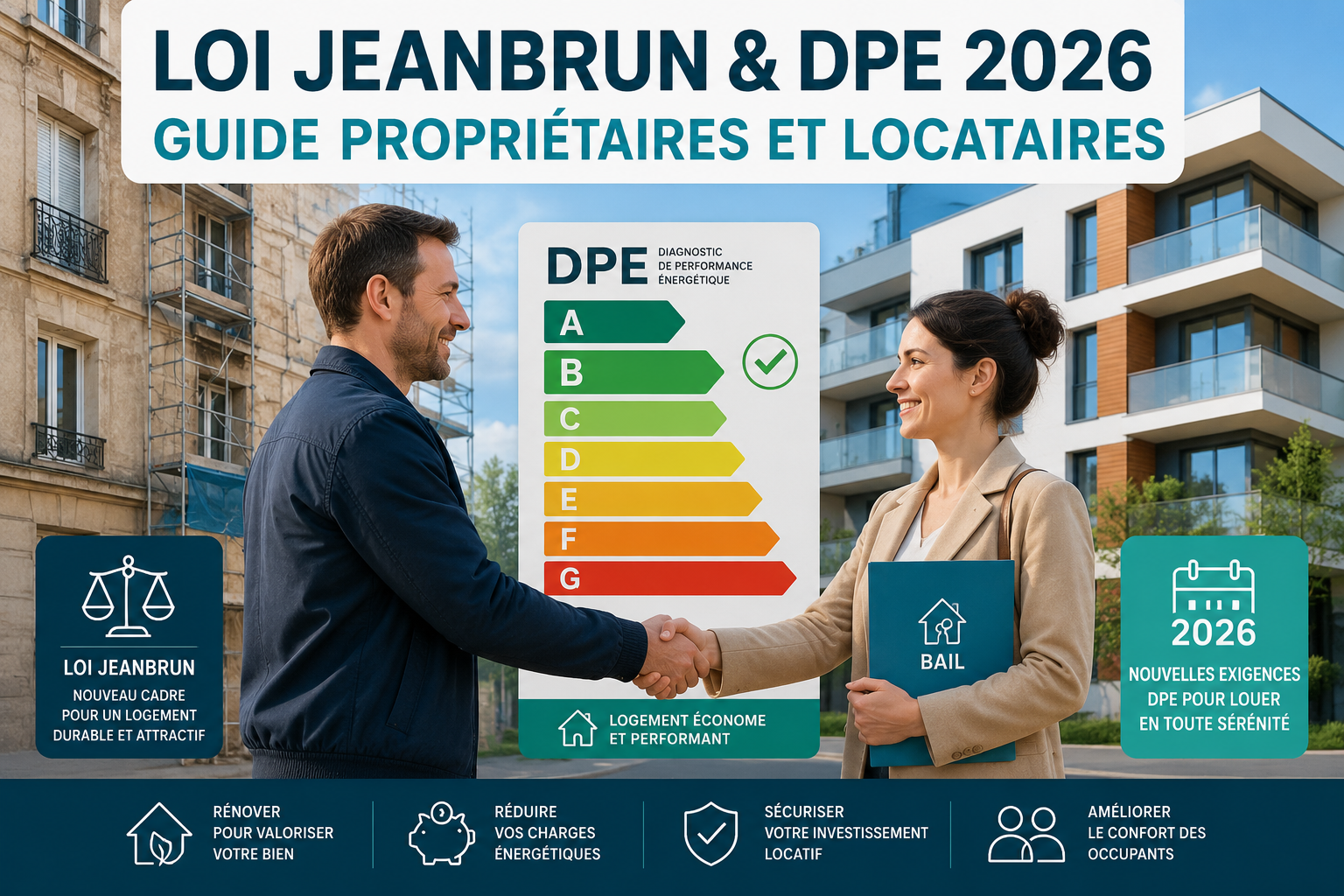
In 2026, the French rental market is undergoing profound change: on the one hand, landlords are benefiting from the brand-new "Relance logement" tax scheme (known as the Jeanbrun Act); on the other, tenants are facing tougher selection criteria and an Energy Performance Certificate (EPC) that has become unavoidable. Understanding both dynamics is essential to navigate effectively through a market under pressure.
What is the "Relance logement" tax scheme (Jeanbrun Act)?
The Jeanbrun scheme, officially named "Relance logement", is the new tax framework for individuals who buy property to rent it out. Enshrined in the Finance Act for 2026, it was adopted via Article 49.3 procedure and came into force on 21 February 2026. It replaces the Pinel scheme, whose expiry at the end of 2024 had contributed to a sharp drop in private rental investment: in 2025, fewer than 10,000 new homes were sold to individual investors, compared with an average of 60,000 per year in previous years.
Its principle is radically different from previous tax relief schemes. Instead of a flat tax reduction calculated on the purchase price, the Jeanbrun Act allows annual depreciation of the property to be deducted from rental income, in addition to the usual expenses (works, mortgage interest, property tax). This mechanism, previously reserved for furnished lettings (LMNP), is now entering the unfurnished lettings sector.
The annual deduction ceilings are set at:
- EUR 12,000 per year for depreciation and expenses
- Up to EUR 10,700 deductible from other income in the event of a property deficit
To qualify, several conditions must be met simultaneously:
- The property must be located in a multi-unit building (detached houses are excluded)
- For a new property: compliance with RE2020 standard; for an older property: works representing at least 30% of the purchase price, with an EPC rating of A or B after works
- Unfurnished letting (without furniture) as the tenant's main residence
- Commitment to let for a minimum of 9 years, with rental ceilings to be respected (intermediate, social or very social levels)
- Prohibition on renting to close relatives up to the 2nd degree (parents, children, brothers and sisters)
The scheme applies without restrictive geographical zoning, anywhere in France, for acquisitions made between 21 February 2026 and 31 December 2028. The government's stated objective: to produce an additional 50,000 private rental homes as early as 2026, and to reach 2 million homes built by 2030.
Warning: in the event of non-compliance with commitments (early sale, uncapped rent, letting to a relative), the tax benefit is fully reclaimed and depreciation already deducted is reintegrated into rental income.
What are the new EPC rules in 2026?
Since 1 January 2026, the Energy Performance Certificate has undergone two major changes that directly affect landlords and tenants.
1. Reform of the electricity conversion coefficient
The electricity-to-primary-energy conversion coefficient has dropped from 2.3 to 1.9. This technical modification automatically improves the energy performance of electrically heated properties: according to ADEME data, nearly 850,000 homes could exit the status of energy sieves (labels F or G) without any works. EPCs carried out before 2026 can be updated free of charge on the ADEME EPC-Audit Observatory platform.
2. Collective EPC extended to all co-ownerships
Since 1 January 2026, the "Climate and Resilience" Act requires a collective EPC for all co-ownerships, including those with fewer than 50 units. This building-wide certificate complements the individual EPC for each flat.
3. The rental ban timetable continues
The phasing-out schedule for energy sieves continues:
- Since 1 January 2025: ban on letting properties rated G
- From 1 January 2028: ban on letting properties rated F
- From 1 January 2034: ban on letting properties rated E
These bans apply to both new lettings and lease renewals. Furthermore, since August 2022, properties rated F or G can no longer be subject to any rent increase.
Finally, old EPCs carried out between January 2018 and June 2021 expired on 1 January 2025: a new certificate is mandatory before any new letting.
Why are tenants facing stricter eligibility criteria?
The combination of the reinforced EPC and rental market tension intensifies pressure on prospective tenants. In France, document fraud has become a structural phenomenon: according to Imodirect (2026), 24% of rental applications in Île-de-France contain at least one fraudulent element (compared with 20% in 2024), and 16% in the provinces.
Faced with this reality, landlords and agencies that lack the tools to detect fakes are tightening their requirements: higher income demanded, permanent contracts almost systematic, guarantor mandatory. Paradoxically, this response fuels a vicious circle: candidates with perfectly solid but atypical profiles (self-employed, fixed-term contracts, temporary workers) find themselves penalised or pushed to embellish their application.
It is precisely this imbalance that Immotecto aims to correct.
How does Immotecto help landlords and tenants cope with this new context?
We have designed an approach that restores clarity for both parties, without judgment and without discrimination.
For the tenant: assemble your application once via TectoDossier (at EUR 0, no fees), gather identity documents, employment status, references and guarantors, then obtain your Tecto Score, a rental reliability indicator calculated solely from actual rent payment history, via Open Banking (PSD2, read-only, at the tenant's initiative) or statement upload. This score, presented on a scale of 0 to 100 with labels (Excellent, Very good, Good, Average, Needs improvement), never analyses income, savings, nationality or age. It measures a single observable behaviour: did they pay their rent, on the due date?
The tenant then generates their TectoPass: a certified PDF passport, shareable instantly via QR code, valid for 40 days. They choose section by section what to share, and see who has viewed their pass. They can send it to any landlord or agency. To view and verify a TectoPass, the professional creates a free Immotecto account (registration required), which includes 10 consultations in total.
For the landlord: in a market where fake applications are on the rise, Immotecto offers AI-powered document concordance checking (Claude Vision analysis) returning a compliant / caution / alert status. Our plans also provide access to the Tecto Annuaire to contact pre-screened tenants directly, without waiting for applications.
The Tecto Score is never presented as the sole selection criterion: in accordance with French anti-discrimination legal obligations, the tenant has a right to explanation, challenge and human review.
Landlord or tenant searching? Discover how TectoPass simplifies connecting, and how our dedicated landlord offers adapt to your situation.
Conclusion: a double-edged reform, a concrete response
The Jeanbrun Act restores attractiveness to private rental investment in France, while the 2026 EPC progressively filters and constrains available supply. In this context, trust between landlords and tenants becomes a rare asset. At Immotecto, we believe that transparency about actual payment behaviour is the best response to ambient mistrust, for both parties.
Ready for the next step? Discover how it works and start building your application or listing today.
FAQ
Who is the Jeanbrun scheme aimed at in 2026?
The Jeanbrun scheme is open to any individual wishing to invest in a rental property located in a multi-unit building, new or renovated (subject to works conditions). It applies without geographical zoning, anywhere in France, for acquisitions made between 21 February 2026 and 31 December 2028. Legal entities not subject to corporate tax are also eligible, provided that rents are taxed under the rental income category.
Can a G-rated property still be let in 2026?
No. Since 1 January 2025, G-rated properties have been banned from letting in mainland France. This ban applies to new lettings as well as lease renewals. F-rated properties will in turn be banned from 1 January 2028. If your EPC dates from before July 2021, it is also invalid and must be redone before any new letting.
What is the Tecto Score and why is it different from a conventional financial score?
The Tecto Score is a rental reliability indicator calculated solely from actually observed rent payments: did they pay their rent, on the due date? It never analyses income, savings, bank balance, nationality or age. It is presented on a scale of 0 to 100 with four verification levels (Not verified, Basic, Verified, Certified) and clear labels. It is not a single selection criterion: the tenant has a right to explanation and human review.
Can a TectoPass be viewed without an account by a landlord?
No. The tenant can send their TectoPass to any landlord or agency. But to view it and verify its authenticity, the professional must create a free Immotecto account (registration required), which includes 10 TectoPass consultations in total. Paid plans exist beyond this quota.
Does the Jeanbrun Act impose energy performance conditions on the rented property?
Yes, in the case of an older property. Works must represent at least 30% of the purchase price, and the property must achieve an EPC rating of A or B after renovation. For new properties, compliance with the RE2020 standard is sufficient. No energy performance condition during the tenancy is imposed, beyond the requirements already applicable to the entire rental stock (ban on letting G-rated properties, rent freeze for F/G).
Sources
- Relance logement : un nouveau dispositif pour faciliter l'achat et la location de logements, Ministère de la Transition écologique et du Logement (ecologie.gouv.fr), 2026, official
- Découvrir le plan Relance logement, info.gouv.fr, 2026, official
- Relance logement Jeanbrun : règles et enjeux PLF 2026, Club Patrimoine (clubpatrimoine.com), 2026, report
- Dispositif Jeanbrun 2026 : barème, plafonds, impôt, Nacarat (nacarat.com), 2026, report
- Relance du logement : un nouveau dispositif pour faciliter l'achat et la location de logements, Actu-Juridique (actu-juridique.fr), 2026, press
- DPE 2026 : obligations pour les propriétaires en 2026, Radiance (radiance.fr), 2026, report
- Ce qu'il faut savoir sur le diagnostic de performance énergétique (DPE), Ministère de l'Économie (economie.gouv.fr), 2026, official
- Réforme du DPE 2025 : ce qui change à partir du 1er janvier 2026, Tucoenergie (tucoenergie.fr), 2025, report
- Crise locative en Île-de-France : les faux dossiers explosent, MySweetImmo (mysweetimmo.com), based on Imodirect, 2026, press
- DPE 2026 : tout savoir sur la réforme du diagnostic de performance énergétique, Immonot (immonot.com), 2025, report