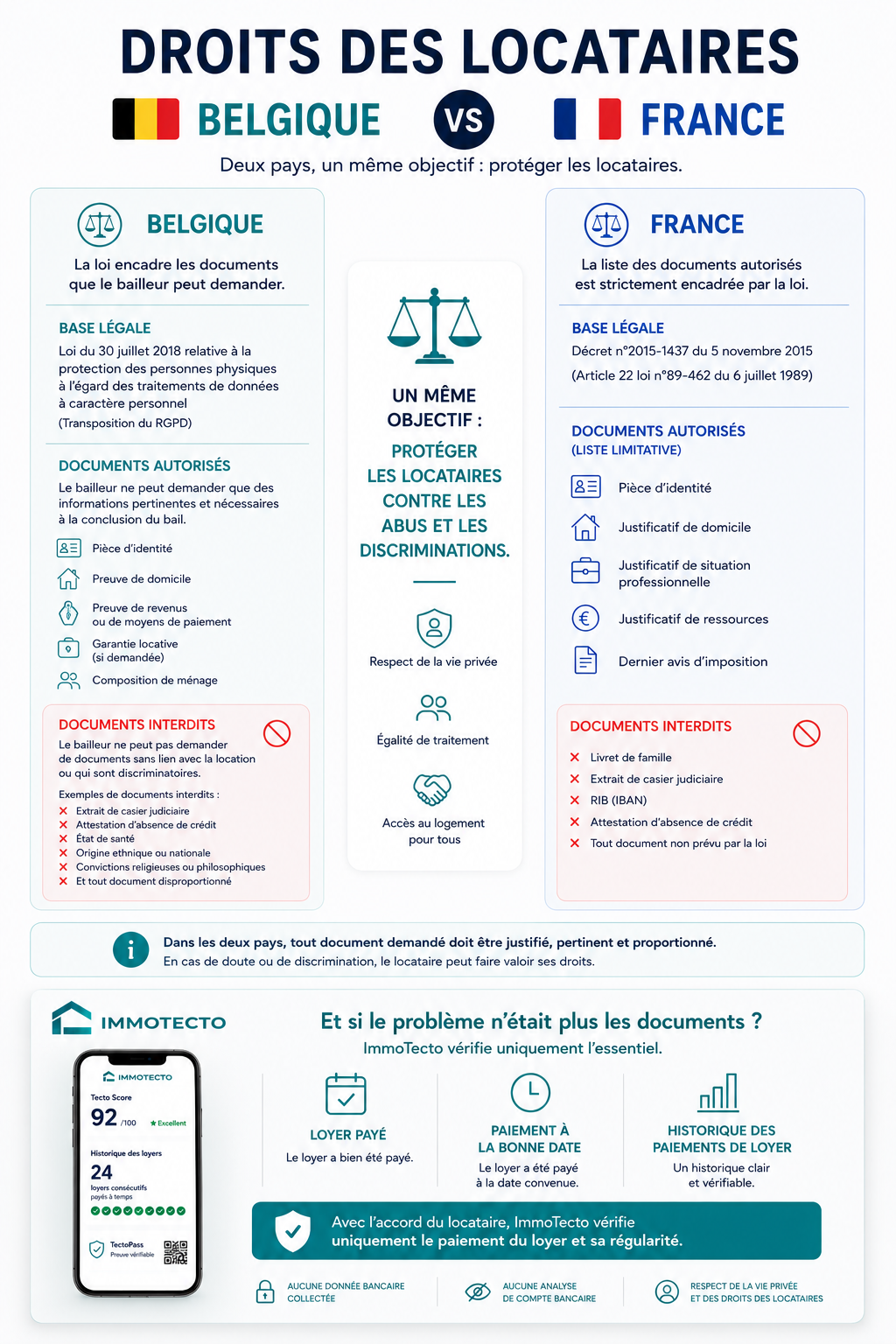
Tenant Rights: Belgium vs France, What Really Changes
Lease agreements, deposits, evictions: Belgian and French rental law differ on many key points. Discover the protections in force in 2025 and how Immotecto secures your rental.
Tenant Rights: Belgium vs France, What Really Changes in 2025
Whether you're a tenant or a landlord, knowing your rights has never been more crucial. The rental market is evolving rapidly, document fraud is on the rise, and legislation is strengthening on both sides of the border. Belgium and France share a similar legal culture, but their lease regulations present major differences that can be decisive. Here's a comprehensive overview of the essential points to know, with a primary focus on Belgian law.
Prove your rental reliability, or verify a candidate's
In Belgium, lease regulations have been regionalised since the 6th State Reform. Concretely, this means that applicable rules vary significantly depending on whether you rent in Brussels, Wallonia or Flanders. This fragmentation is unique in Europe and requires both tenants and landlords to understand the specificities of their region.
In Brussels, the ordinance of 4 April 2024, which came into force on 1 November 2024, introduced significant changes:
Rent must now be paid by bank transfer; cash payment is prohibited.
Between two successive short-term leases, rent cannot be increased beyond the annual indexation for a period of 9 years.
Any new short-term lease must state the rent applied to the previous tenant, otherwise a fine of up to €200 may be imposed.
The rental deposit is capped at 2 months' rent excluding charges in Brussels and Wallonia, compared to 3 months in Flanders.
The landlord has 2 months after the end of the lease to return the deposit, otherwise they must pay 10% of the rent per month of delay.
Clauses prohibiting pets are now null and void.
In Flanders, the decree of 9 November 2018 regulates leases with similar rules but some particularities, notably regarding notice periods. The standard duration for primary residence leases remains set at 9 years in all Belgian regions.
What Belgian law truly protects
Belgian tenants benefit from strong protective measures. During the lease, major repairs, structural works and upgrades to meet standards remain the landlord's responsibility. In case of a major problem rendering the dwelling uninhabitable, the tenant can request a rent reduction, temporary suspension or even early termination of the lease.
Another notable protection introduced in Brussels: the right of first refusal. If a landlord decides to sell their property, the tenant now has priority to purchase the accommodation they occupy, provided they have a long-term unfurnished lease and are officially registered at that address.
Regarding evictions, the law is strictly regulated. A prior formal notice is mandatory before any legal proceedings. The landlord can only initiate proceedings one month after serving notice to the tenant. And since 2024, evictions are prohibited during the winter period, from 1 November to 15 March.
French rental law: a more uniform national framework
In France, the legal framework is national and primarily based on the law of 6 July 1989, enriched by successive reforms. In 2025, developments are significant, particularly regarding energy performance.
The major differences with Belgium:
The minimum lease duration is set at 3 years for private landlords and 6 years for legal entities, compared to 9 years in Belgium for primary residences.
The security deposit is capped at 1 month's rent excluding charges for an unfurnished rental, and 2 months for furnished accommodation. In Belgium, the cap is 2 months for standard rentals in Brussels and Wallonia.
The French winter truce runs from 1 November to 31 March, two weeks longer than the Belgian truce which ends on 15 March.
In 2025, properties rated G on the Energy Performance Certificate are prohibited from being rented in France. Properties rated F will follow progressively.
In high-demand areas, automatic rent control applies, limiting increases to the Rental Reference Index.
Tenants can give notice with one month's notice in high-demand areas, or 3 months in other cases.
Rental fraud: a phenomenon affecting both countries
Whether in Belgium or France, fraud in rental applications has become a major issue for landlords. French statistics indicate a 40% increase in falsified rental applications in one year. In Belgium, the fight against social fraud recovered €414 million in 2025, demonstrating the scale of the phenomenon at all levels.
The most frequently falsified documents remain payslips, employment contracts and tax notices. Faced with this reality, real estate professionals are calling for reliable and fast verification tools.
This is exactly the solution we've provided at Immotecto.
Tecto Score and TectoPass: rental reliability through real data
We founded Immotecto around a simple conviction: a tenant application should be based on real banking data, not on documents that are too easy to falsify. Our Tecto Score is a rental reliability score from 0 to 110, completely free, calculated from real banking data via Open Banking. This is not an estimate, but an objective analysis of the applicant's actual financial behaviour.
For tenants who want to stand out, the TectoPass is a certified PDF, available at €9.99, instantly verifiable by QR code and usable outside our platform. It constitutes credible proof of reliability, whether the landlord is Belgian, French or from elsewhere.
Whether you're a tenant seeking to convince a landlord, or a landlord wanting to secure your selection process, visit immotecto.com to obtain your Tecto Score for free or order your TectoPass. In a tight rental market, transparency is your best asset.